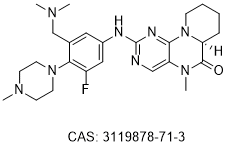
IHMT-HPK1-550 is a potent, selective amd orally bioavailable HPK1 (MAP4K1) inhibitor with IC50 of 6.0 nM, inhibits HPK1 signaling and enhances cytokine production in T cells.
IHMT-HPK1-550 is docked into the HPK1 ATP-binding pocket.
IHMT-HPK1-550 exhibits 13-fold selectivity for HPK1 over GLK, demonstrates excellent selectivity: only five off-target kinases (NUAK1, ULK1, GLK, KHS, and QIK) against a panel of 275 kinases at 0.1 uM.
IHMT-HPK1-550 displays minimal inhibitory activity (<50% inhibition at 0.1 μM) against key TCR signaling kinases, including ZAP70, LCK, FYN, ITK, and JAK1/2/3, all of which are critical for proper immune cell activation.
IHMT-HPK1-550 enhanced the secretion of IL-2 and IFN-γ in a dose-dependent manner in anti-CD3/CD28-stimulated Jurkat cells and human peripheral blood mononuclear cells (PBMCs), specifically, at 0.014 μM, it increased IL-2 secretion by approximately 2-fold, and this enhancement reached more than 4-fold at 0.371 μM.
IHMT-HPK1-550 dose-dependently reduced p-SLP-76 levels and almost completely inhibited p-SLP-76 at 0.03 μM in anti-CD3/CD28-stimulated Jurkat cells and human peripheral blood mononuclear cells (PBMCs).
IHMT-HPK1-550 inhibits HPK1 signaling and enhances cytokine production in T cells.
IHMT-HPK1-550 (10 and 40 mg/kg, orally administered) exhibited tumor growth inhibition (TGI) values of 18.6% and 48.1%CT26.WT syngeneic mouse model.
IHMT-HPK1-550 enhances the therapeutic efficacy of anti-PD-1 by normalizing the immunosuppressive tumor microenvironment and recruiting abundant cytotoxic T lymphocytes into the tumor.